

5 key forces shaping the market outlook after Labor Day
Review the latest Weekly Headings by CIO Larry Adam.
Key takeaways
- Fiscal sustainability has returned to the spotlight
- Debt has become a critical funding source for hyperscalers
- 2026 may mark peak earnings growth, but not peak earnings
Labor Day signals more than summer’s end. It marks a return of focus to the economic and market forces that will shape the remainder of the year. From resilient earnings and record AI spending to rising bond yields and the midterm elections, there is no shortage of forces shaping the market outlook. Below, we examine several key questions facing investors and share our perspective on how these trends may unfold in the months ahead.
Is the consumer tapped out?
Recent data suggest consumers are becoming more selective, as retail sales soften, some retailers report signs of strain, and the savings rate remains low. With consumer spending accounting for ~70% of GDP, any slowdown bears scrutiny.
Our View: The consumer is not tapped out, but spending is increasingly reliant on higher-income households. Strong balance sheets, rising asset values and wealth gains continue to support spending at the top end, while lower-income consumers remain pressured by higher living costs and limited savings. This imbalance leaves consumption more vulnerable to inflation, labor market weakness or other shocks. For now, affluent consumers continue to power spending, helping sustain economic growth.
Will the growing US national debt trigger a crisis?
Last month, the national debt surpassed $40 trillion for the first time, roughly double 2017 levels. As fiscal sustainability returns to the spotlight, concerns about a potential debt crisis are growing.
Our View: Rising debt, persistent deficits, and higher interest costs (now over $1 trillion annually) are increasing pressure on government finances. Yet despite years of warnings, a debt crisis has yet to emerge. Could this time be different? While risks are building, we believe the US has more flexibility than many headlines suggest. The US borrows in its own currency, the dollar remains the world’s reserve currency, and demand for Treasuries remains solid despite heavy issuance. Eventually, Congress will need to address the fiscal trajectory. For now, however, the greater risk is not a sudden debt crisis, but a gradual erosion of fiscal flexibility over time.
Is AI debt issuance driving yields higher?
As hyperscalers race to build AI infrastructure, debt has become a critical funding source. With AI spending likely to exceed ~$1 trillion annually from 2027-2030, some investors worry that AI-related borrowing is pushing bond yields higher.
Our View: AI-related debt issuance has surged, with hyperscaler borrowing rising from an annual average of $22 billion in 2022-2024 to $93 billion in 2025. Year-to-date (YTD) issuance is approaching ~$160 billion and exceeds $220 billion including foreign currency issuance. While still modest relative to the overall corporate bond market, the rapid increase is creating pockets of supply pressure. Hyperscalers accounted for ~1% of investment grade issuance in 2024 versus about 10% YTD, with nearly half issued at longer maturities. That may be contributing to higher yields at the margin, but it is not the primary driver. Importantly, demand remains strong, with many deals oversubscribed by ~3-to-1. In addition, hyperscalers continue to deliver robust earnings growth, helping justify the massive investments being made in AI infrastructure.
Does peak earnings growth imply earnings have peaked?
With 2Q26 earnings posting their strongest gain in five years, up 51% year over year including one-time investment gains, investors are asking whether the level of earnings has reached its high-water mark.
Our View: After stronger than expected results in both 1Q26 and 2Q26, consensus forecasts call for S&P 500 earnings to grow 33% for all of 2026, the fastest pace since 2010. Consensus expects earnings growth to moderate to 15% in 2027, suggesting this year may mark the peak in earnings growth, but not peak earnings. Profits are still projected to rise next year and reach another record high, just at a slower pace. This year's outsized gains were boosted by two one-time factors: non-cash investment revaluation gains at several mega-caps and IEEPA tariff refunds across a range of companies. As those tailwinds fade, earnings growth should normalize, but the broader earnings outlook remains positive and supportive for the continuation of the equity bull market.
Will the midterm elections move the markets?
With just 60 days until the midterm elections, Washington is moving back into investors’ focus. While elections can spark headlines and increase volatility, their market impact is often short-lived.
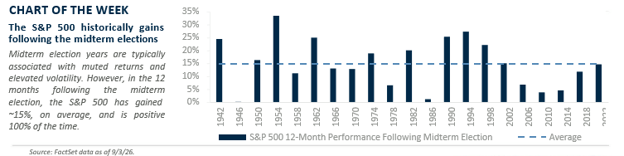
Our View: Politics matters, but we believe the economy, earnings, the Fed, and valuations matter more. Volatility often rises around midterm elections, yet history suggests those swings are temporary. Since 1942, the S&P 500 has produced a 15% average return and been positive 100% of the time in the 12 months following a midterm election, regardless of the outcome. While conventional wisdom suggests markets perform best under divided government, we are less convinced, as it reduces the likelihood of fiscal stimulus providing support to the economy.
All expressions of opinion reflect the judgment of the author(s) and the Investment Strategy Committee and are subject to change. This information should not be construed as a recommendation. The foregoing content is subject to change at any time without notice. Content provided herein is for informational purposes only. There is no guarantee that these statements, opinions or forecasts provided herein will prove to be correct. Past performance is not a guarantee of future results. Indices and peer groups are not available for direct investment. Any investor who attempts to mimic the performance of an index or peer group would incur fees and expenses that would reduce returns. No investment strategy can guarantee success.
Economic and market conditions are subject to change. Investing involves risks including the possible loss of capital.
The information has been obtained from sources considered to be reliable, but we do not guarantee that the foregoing material is accurate or complete. Diversification and asset allocation do not ensure a profit or protect against a loss.
The S&P 500 Total Return Index: The index is widely regarded as the best single gauge of large-cap U.S. equities. There is over USD 7.8 trillion benchmarked to the index, with index assets comprising approximately USD 2.2 trillion of this total. The index includes 500 leading companies and captures approximately 80% coverage of available market capitalization.
Sector investments are companies focused on a specific economic sector and are presented here for illustrative purposes only. Sectors, including technology, are subject to varying levels of competition, economic sensitivity, and political and regulatory risks. Investing in any individual sector involves limited diversification.
